CMS (Content Management System)
Introduction to Content Management System
Content Management System (CMS)
Introduction to CMS
A Content Management System (CMS) is a computer software application used to manage the creation and modification of digital content. It provides a user interface that allows people to build and update websites without needing to write raw code from scratch.
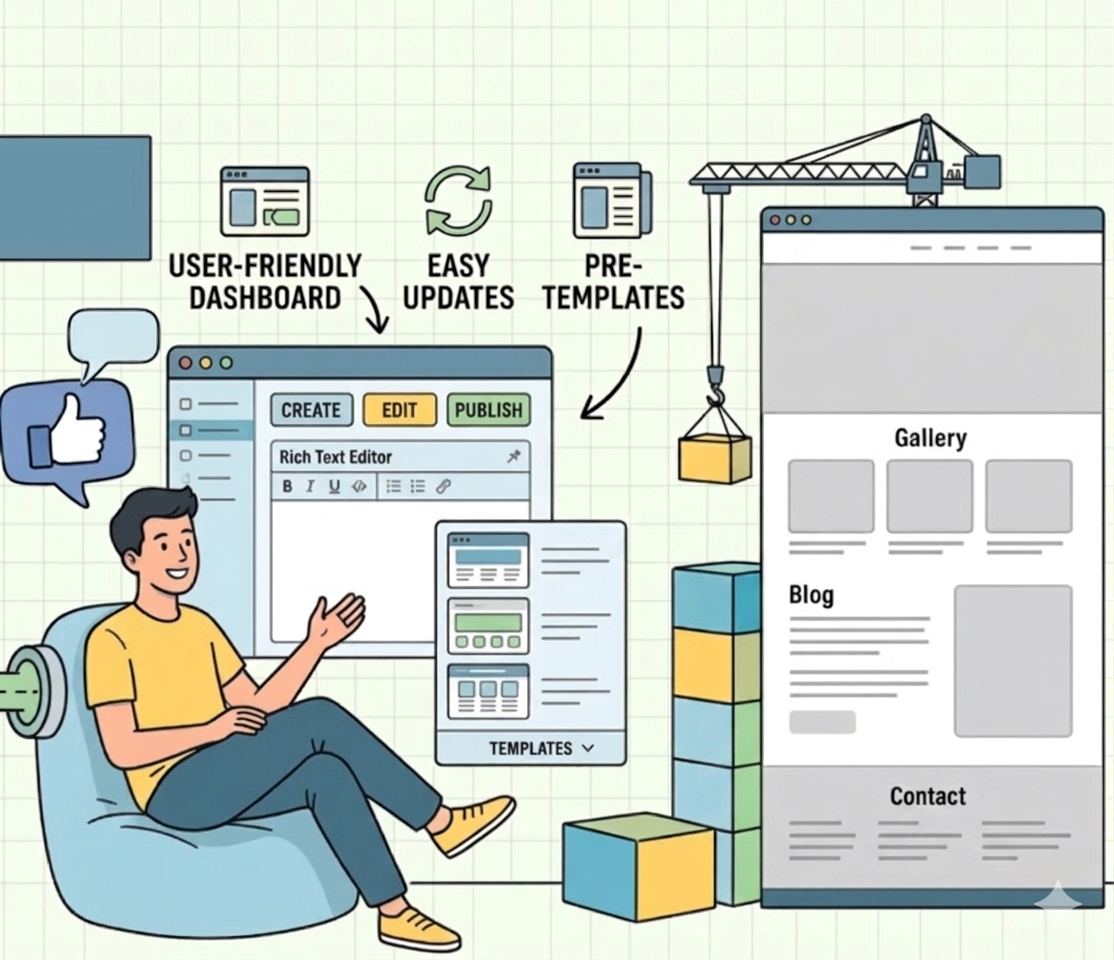
Think of a CMS like having the backend of a social media app for your own entire website. You don't have to understand the complicated computer science behind how images upload or how buttons work. You simply log in to a dashboard, pick a cool-looking template, type your content, and hit "publish" to make it live for the world to see. It’s essentially a professional shortcut for making a website look great without being a coding expert.
From an architectural standpoint, a CMS is typically comprised of two core components: a Content Management Application (CMA) and a Content Delivery Application (CDA). The CMA provides the front-end user interface that allows for the creation and removal of content without webmaster intervention, while the CDA compiles that content to update the website. Traditional (monolithic) systems tightly couple the content repository, the database, and the presentation layer into a single unit. In contrast, modern headless CMS architectures decouple the backend repository from the frontend presentation layer. They treat content as structured data (typically JSON) that is served via REST or GraphQL APIs, enabling omnichannel delivery to websites, mobile apps, IoT devices, and smart displays simultaneously.
History of CMS
- The Pre-CMS Era (1990–1995): Static Web 1.0
In the earliest days of the World Wide Web, websites consisted of static HTML pages. Managing content was a manual, time-consuming "nightmare" that required developers to review hundreds of lines of raw code to change even a single typo.
- Key Milestones: Tim Berners-Lee proposed HTML in 1989 and wrote the first web browser and server in 1990.
- Early Tools: Around 1991, Server Side Includes (SSI) allowed developers to separate small portions of a site, like menus or footers, from the main content.
- Monolithic Enterprise Systems (1995–2000)
The mid-90s saw the introduction of server-side scripting (PHP, ASP, and later JSP), which enabled the creation of dynamic web pages. This period birthed the first "natural" content management system.
- The First CMS: FileNet introduced the first complete integrated document management solution in 1995.
- Defining the Term: Vignette, founded in 1995, is widely credited with originating the term "content management system".
- Enterprise Adoption: Other major players like Documentum (1996), Interwoven (1995), and Sitecore (1999) emerged to handle complex corporate documentation and web content.
- Open-Source and Web 2.0 Democratisation (2000–2010)
The early 2000s marked the "democratisation" of the web. Open-source platforms emerged, allowing non-technical users to build and publish websites without knowing HTML or CSS.
- Drupal arrived in 2001, followed by WordPress in 2003 and Joomla in 2005.
- The "Web 2.0" era prioritised user-generated content and interactivity, supported by revolutionary breakthroughs like Ajax, which let pages update without reloading.
- Platforms like Squarespace (2003) and Wix (2006) began providing low-cost, template-based alternatives for small businesses.
- The Mobile-First and Headless Revolution (2010–2020)
As smartphones like the iPhone (2007) and Android (2008) became dominant, the traditional monolithic CMS struggled to deliver content across both desktop and mobile platforms. The Responsive Shift: In 2010, the concept of responsive design was introduced to help websites adapt to different screen sizes
- Headless CMS: To solve the "omnichannel" problem, headless architecture emerged. By decoupling the backend content repository from the frontend presentation layer, headless systems (like Contentful and Strapi) allowed content to be delivered via APIs to any device, including smartwatches and IoT displays.
- Modern Era: DXPs, AI, and Content Operating Systems (2020–2026)
Today, the CMS has evolved into the Digital Experience Platform (DXP). These platforms no longer just manage content; they orchestrate the entire customer journey by integrating analytics, CRM, and e-commerce into one ecosystem.
- AI Integration: Modern systems use Artificial Intelligence for automated tagging, real-time personalization, and predictive content recommendations.
- Content Operating Systems: Forward-thinking platforms now position themselves as "content operating systems," managing the entire lifecycle of content from modeling to automated omnichannel delivery.
- Agentic Platforms: Recent innovations, such as Contentstack’s Agentic Experience Platform, focus on AI-driven automation to further reduce the "content bottleneck"